Bridal shopping list: the complete Indian wedding checklist
A complete Indian bridal shopping list: outfits for every function, jewellery, footwear, beauty, trousseau, ritual items and gifts, the groom’s list, and when to buy each, month by month.
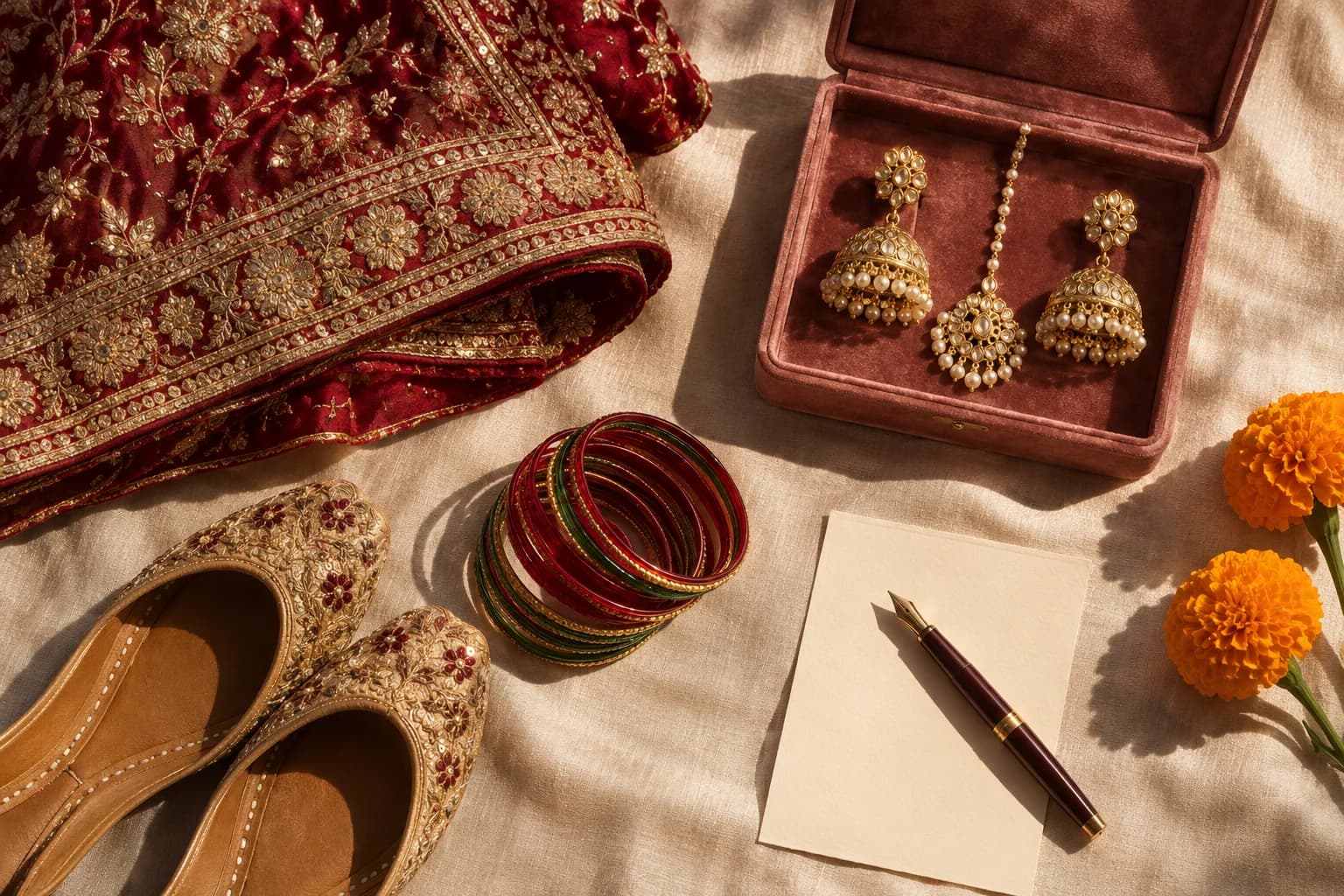
An Indian bridal shopping list has seven parts: outfits for each function, jewellery, footwear and accessories, beauty and skincare, the trousseau, items for the rituals, and gifts. Start with the wedding outfit about six months ahead, add the rest as colours are fixed, and leave ritual items and gift packing for the last month.
Before you shop, write down every function you are holding and who pays for what. A list built around your own functions is shorter than any generic checklist, and every item on it has a budget line. Customs vary widely between communities and families, so treat the lists below as a starting point and ask your elders what your family expects.
Agree early on who buys what. In many families the groom’s side gives the mangalsutra and some of the bridal jewellery or outfits, and the bride’s family covers her trousseau and the gifts for the groom’s family, but this differs from one community to the next. One shared list for both families stops you buying two of anything.
Outfits for every function
- Roka or sagai: a lehenga, saree or suit, usually lighter than the wedding outfit; one outfit if they are held together
- Haldi: something yellow that you do not mind staining, plus an old dupatta for the turmeric
- Mehndi: a bright outfit, often green or pink, with sleeves that roll up or a sleeveless blouse, since you will sit for hours
- Sangeet: something you can dance in, with a skirt light enough to twirl and a secure dupatta
- Wedding: the bridal lehenga or saree, a second dupatta if you want a veil and a drape, the blouse, a cancan or petticoat, and shapewear
- Reception: a gown, a lighter lehenga or a saree, in a colour that works under stage lights
- After the wedding: two or three sarees or suits for the first visits, pooja and family dinners
- One spare outfit for any function that is added later, which nearly always happens
Red is the traditional wedding colour for many North Indian brides, the same red that marks sindoor and bangles, but plenty choose pink, ivory or gold. Haldi and mehndi have their own customs and colours, explained in our guides.
Haldi ceremony meaning: why turmeric comes before the wedding
Mehndi ceremony meaning: why the groom’s name is hidden in the henna
Jewellery
- Bridal set: necklace or haar, earrings, maang tikka and nath (nose ring)
- Bangles: glass or lac to match the outfit, plus gold kangan or kadas
- Haathphool, bajuband (armlet) and kamarband (waist chain), if your look includes them
- Payal (anklets) and bichhiya (toe rings), usually silver
- A lighter set for each other function, and floral or artificial jewellery for haldi and mehndi
- Rings for the engagement, if you exchange them
- Pouches or a travel case to keep every set together
Which pieces count as the solah shringar, the sixteen adornments of a bride, differs from region to region, so ask what your family includes. When you buy gold, check for the three-part BIS hallmark: the BIS logo, the purity (such as 22K916) and a six-digit HUID code, which you can verify in the government’s BIS Care app. Ask for a bill that shows the net weight, purity and charges for each piece.
Footwear and accessories
- Wedding heels, wedges or juttis, bought before your fittings so the hem is set to them
- Comfortable flats or padded juttis for long functions and the pheras
- A clutch or potli for each main outfit
- Dupatta pins, safety pins, bobby pins and fashion tape
- Hair accessories, and a gajra or flowers ordered from your florist
- Shapewear, nude innerwear and blouse padding to wear at every fitting
- Sunglasses and a shawl or jacket for outdoor and winter functions
Beauty and skincare
- Book your makeup and hair artist early, and have a trial at least two weeks before the wedding
- Settle your skincare routine months ahead and introduce nothing new in the last month
- Patch-test any new product for a week or more before using it on your face
- Sunscreen for every day before the wedding
- A touch-up kit: lipstick, compact, kajal, blotting papers, wipes and a small mirror
- Nail colour, hair care, perfume and a hairdryer if you are travelling
- Natural henna cones only: ask your artist what is in them
Dermatologists commonly advise against first-time peels, lasers and new products in the final weeks, because there is no time for irritation to settle. Natural henna stains orange to reddish brown; ‘black henna’ can contain PPD, a hair-dye chemical that may cause severe skin reactions.
Trousseau and everyday wear
The trousseau is the bride’s own wardrobe for her new life: clothes, accessories and, in many families, household linen. Buy for the life you will actually live, not only for the first week of visits.
- Sarees, suits or kurtas for the first months, a mix of dressy and easy
- Everyday clothes for work and home
- Nightwear and comfortable loungewear, including a set that is fine to be seen in
- Lingerie and innerwear
- Clothes for the honeymoon, checked against the weather there
- A shawl or jacket for winter
- Luggage, toiletries and a small medicine kit
- Bedsheets or towels, if your family includes them
Items for the rituals
These items are common across many North Indian Hindu weddings, but who buys them, and whether you need them at all, depends on your community and family. Ask your pandit for the samagri list for each ceremony, and ask both families which side brings what.
- A chunri or odhni for the pheras, often red
- Glass or lac bangles for the bride, and for Punjabi brides the chooda and kaleere, the chooda traditionally from her maternal uncle
- Sindoor and a sindoor box for the sindoor daan
- The mangalsutra, which the groom ties during the wedding and which his family often buys
- Bichhiya and payal, if they are given at the wedding
- Haldi ingredients: turmeric, gram flour, sandalwood and rose water or milk
- Mehndi cones for the bride, family and guests
- Rice and a small kalash for the vidaai and the welcome at the groom’s home
- Shagun envelopes, coconuts and mauli (red thread)
- Everything on the pandit’s list, bought and packed per ceremony
Other traditions have their own essentials: a Bengali bride’s shankha, pola and loha bangles and alta, a Tamil bride’s thaali and metti, and different lists again for Sikh, Muslim, Christian and Jain weddings. Ask the elders of both families before you buy anything.
Gifts
- For the groom: a gift from you, if your families exchange them (a watch, cufflinks or something personal)
- For the in-laws: clothes, sweets and dry fruits for the exchanges your families hold, such as at the roka or sagai
- For bridesmaids and cousins: matching dupattas or bangle sets for a function, or small jewellery
- Return gifts for guests: sweets or dry fruits, or something useful such as stoles or small décor
- Packing: trays, baskets, boxes, ribbon and shagun envelopes, bought in bulk
The groom’s list, in brief
- Wedding: a sherwani, achkan or bandhgala, with churidar or trousers
- Other functions: kurta sets for the haldi, mehndi and sangeet, and a suit or bandhgala for the reception
- Safa or pagdi, a kalgi (turban brooch) and, in many North Indian families, a sehra
- Mojris or juttis, plus comfortable shoes
- A stole, a mala, cufflinks and a watch
- Grooming: haircut, facial and skincare started early, and a touch-up kit
When to buy what: a month-by-month timeline
- Six months or more: fix your functions, budget and colour palette, and start looking for the wedding outfit. Heavily hand-embroidered custom lehengas can need six to nine months.
- Four to five months: order the bridal outfit by now at the latest, since custom embroidery often takes 8 to 12 weeks. Book the makeup artist and order the groom’s sherwani.
- Three months: buy the bridal jewellery once the outfit colours are fixed, then outfits for the other functions, footwear and bulk return gifts.
- Two months: trousseau, bridesmaids’ outfits and accessories. Expect the first fitting about eight to ten weeks before the wedding.
- One month: ritual items from the pandit’s list, gift packing, the makeup trial, and no new skincare.
- Two to three weeks: final fitting, wearing your wedding shoes and jewellery.
- Last week: collect everything, and pack one labelled bag per function with the outfit, jewellery, shoes and pins together.
Budgeting tips
Give shopping its own lines in your wedding budget before you set foot in a market. Our free budget calculator’s starting split puts 8% of the total on attire and 6% on rings and jewellery, with gifts and favours as a separate line; change any share to fit your wedding.
- Spend most on the outfit and jewellery you will wear longest or keep, and less on one-time looks
- Re-wear the wedding jewellery at the reception, or the sangeet lehenga at a later wedding
- Buy matching dupattas, bangles and return gifts in bulk, where the price per piece drops
- Ask whether a price includes alterations, GST and making charges before you agree to it
- Keep 5 to 10% aside for last-minute items, because there are always some
- Record every advance as you pay it, with the bill photographed on your phone
Open the free wedding budget calculator
How to use the wedding budget calculator for Indian weddings
Best places for wedding shopping in Delhi (2026 guide)
Best places for wedding shopping in Mumbai (2026 guide)
Wedding shopping in Jaipur: where to buy what (2026 guide)
Quick answers
- What should be on a bride’s wedding shopping list? Outfits for each function, jewellery, footwear and accessories, beauty and skincare, the trousseau, ritual items and gifts.
- When should I start bridal shopping? About six months before the wedding, starting with the bridal outfit. Custom lehengas with heavy embroidery need longer.
- How many outfits does an Indian bride need? Usually one per function, plus two or three for the days after the wedding and a spare.
- What is included in a trousseau? The bride’s clothes, accessories and toiletries for her new life, and in many families household linen too.
- Who buys the mangalsutra? It depends on the family, but in many North Indian weddings the groom’s family buys it and the groom ties it.
- How much of the wedding budget goes on the bride’s shopping? There is no fixed share. As a starting point, our budget calculator puts 8% on attire and 6% on rings and jewellery.
Written by Inviteeq Editorial, with care for every celebration. How we write and check these stories