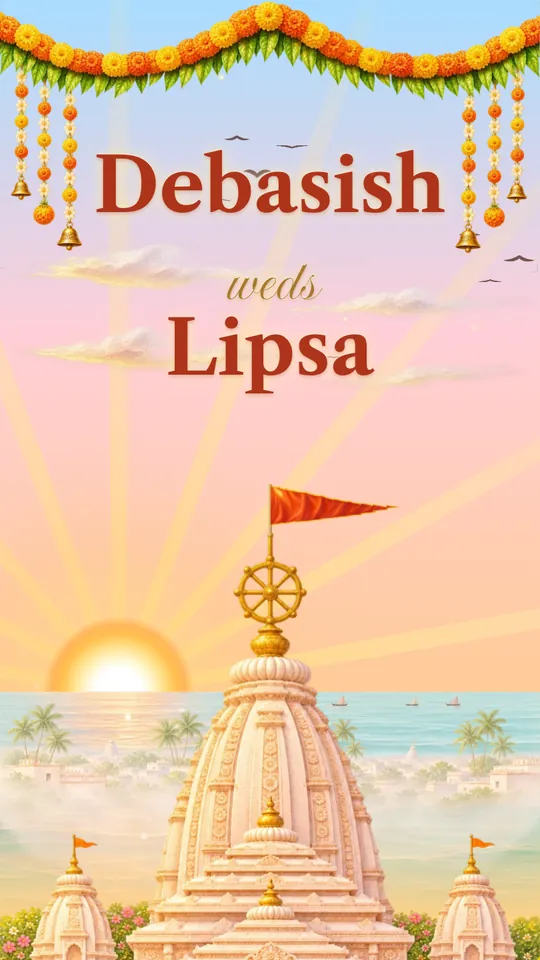
What goes on an Odia wedding invitation
The Odia Hindu wedding is the bahaghara, and its invitation card is the nimantrana patra. Many Hindu families open a card with a shloka or an invocation; for an Odia card, one choice is the popular chant “Jai Jagannath”. Below it, the bride’s or groom’s parents invite guests to the marriage of their daughter or son.
- The date of the bibaha and the muhurat, the auspicious time fixed for it. Some weddings are held in the morning or at midday and others in the evening or at night, so give the full window.
- The bride’s and groom’s names with their parents’ names, and where the other family is from.
- Each function with its date, time and venue, whether the bride’s home, the groom’s home, a temple or a hall, with a map link.
- The hosts’ names at the close.
The ceremonies and their usual order
Rites and their names differ between families, castes and districts, but a common sequence runs like this:
- Nirbandha: the engagement, at the bride’s home or a temple. The two fathers make a vow, the sankalpa, to marry their children to each other, gifts are exchanged and the wedding is fixed.
- Jwain anukula: the start of the wedding rites at the groom’s home, after which the invitations go out.
- Mangana: usually the day before the wedding, turmeric paste is applied to the bride and she is bathed in the presence of seven married women. The groom has his own turmeric rite.
- Diya mangula: the bride’s sari, bangles and sindoor are offered at the temple of the village goddess, with prayers for a long and happy married life.
- Barajatri: the groom’s procession arrives at the wedding venue, and he is welcomed with an aarti or a tilak.
- Bibaha: the wedding, with kanyadaan; hatha ganthi, when the couple’s hands are tied with a garland of mango leaves; and saptapadi. The groom then puts sindoor in the bride’s hair parting and sankha bangles on her wrists.
- Kaudi khela: after the wedding, the newly-weds play a light-hearted game with a cowrie shell while the bride’s family looks on. Families play it in different ways.
Chauthi, on the fourth day, and asta mangala, when the couple visit the bride’s home on the eighth day, are family occasions, so you may leave them off the guest invitation. The Jagannath Dham template's sample lays out a nirbandha, mangana, bibaha and kaudi khela, and you can add any other function.
Who is invited first, and who invites whom
Odia invitations go out in an order of their own. By custom the first card goes to the family deity, and in many families it is placed before Lord Jagannath or taken to the temple at Puri, its edges marked with haldi and chandan. The next goes to the maternal uncles, carried in person by a family member with betel nuts.
Then comes the jwain nimantrana: the bride’s father and other men of her family visit the groom’s home to invite him in person. In Odisha this invitation to the groom has traditionally been written on palm leaf. A digital invitation does not replace these visits; it is for everyone else, with every function on one link. Guests reply for each function separately, and you see each family’s reply and headcount.
When to send it, and what guests need to know
Send the invitation four to six weeks ahead, earlier for guests travelling to Odisha. Name the muhurat and the venue clearly, and say when the barajatri arrives and when the bhoji, the wedding feast, is served.
Say plainly whether the wedding is in the daytime or at night. Utkala Brahmin weddings are traditionally held in the daytime, while many other families marry in the evening or at night. This page follows Odia Hindu customs, which vary between castes and districts, so check the details with your family’s elders and priest.
Wording you can copy
Copy any of these and change the names, dates and times to your own.
Fill in your own names, date and venue with the wording generator
ଜୟ ଜଗନ୍ନାଥ
Jai Jagannath
Shri Rabindra Panda and Smt. Anita Panda request the honour of your presence at the marriage of their daughter Lipsa with Debasish son of Shri Prasanta Mohapatra and Smt. Sasmita Mohapatra Friday, 12 February 2027 Muhurat: [time] to [time] Kalinga Lawns, Nayapalli, Bhubaneswar The barajatri arrives at 5 pm, and the bhoji follows the wedding. Your presence and blessings are our joy.
With the blessings of our families, we, Lipsa and Debasish, are getting married. Join us for our bibaha on Friday, 12 February 2027, in Bhubaneswar, and for the reception on Sunday.
Nirbandha: Friday, 5 February 2027, 11 am, at the bride’s family home in Bhubaneswar Join us as our families give their word and the wedding day is fixed.
Please tell us by 15 January whether you will join us for the nirbandha, the bibaha, the reception or all three.