Kanyadaan meaning: the promise behind the ritual
Kanyadaan is not just “giving the daughter away”. Learn what the ritual means, the Sanskrit vows the father and groom exchange, and how Panigrahan follows.
Kanyadaan is one of the most emotional moments of a Hindu wedding, and one of the most misunderstood. Most of us grow up hearing it explained as the father “giving his daughter away”. Sit close to the mandap and listen to the Sanskrit, though, and you hear something different: a father asking for a promise, out loud, before both families, and a groom giving it.
What does Kanyadaan mean?
The word joins kanya, a maiden or daughter, and daan, a gift. It is usually translated as “the gift of a daughter”, and many families call it the mahadaan, the greatest gift a parent can give. In most North Indian ceremonies it comes after the jaimala and before the pheras, and the bride’s parents perform it. In many families they keep a fast until it is done.
The ritual has regional names and forms. South Indian weddings call it kanyadaanam, and Bengali weddings have their own version, sampradan. The heart of it is the same: the bride’s family, in front of the sacred fire and their guests, entrusts her to the groom on conditions he must accept.
How Kanyadaan is performed
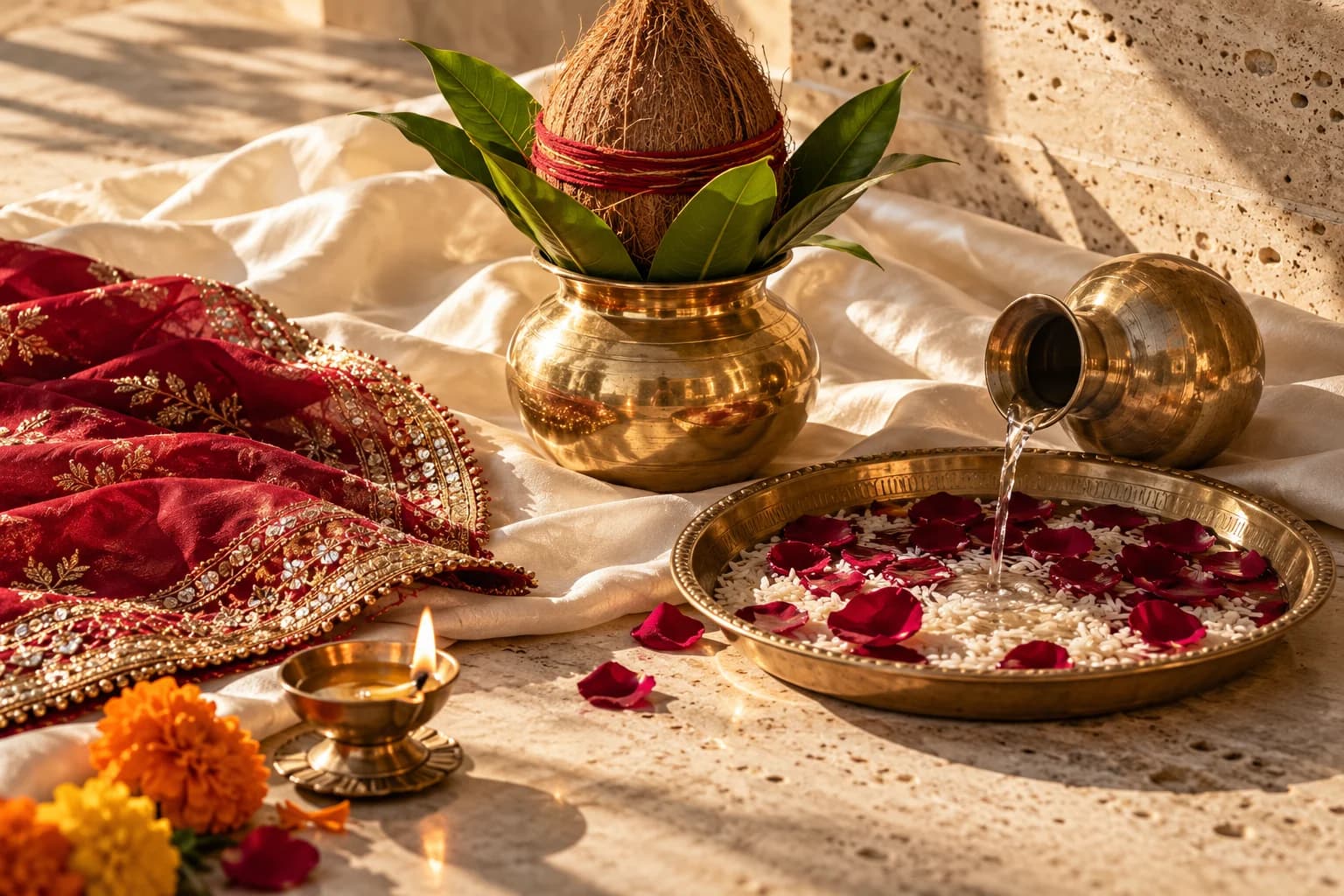
The pandit begins with a sankalp, a statement of intent that names the place, the date and both families, often with their gotras. The father, usually with the mother beside him, then places the bride’s right hand in the groom’s right hand. Water is poured over their joined hands from a brass kalash or lota, often with flowers, rice grains, a betel leaf or a coin.
- The sankalp: the pandit states the purpose of the ritual and names both families
- The joining of hands: the father places his daughter’s hand in the groom’s
- The water: poured over the joined hands, often by the mother
- The promise: the groom’s vow, spoken before the hands are released
The promise most guests miss
Before letting go of her hand, the bride’s father asks the groom for a commitment. The words are recited in Sanskrit, usually by the pandit on the families’ behalf, so most guests never catch them:
धर्मे च अर्थे च कामे च नातिचरितव्या। Dharme cha arthe cha kame cha naticharitavya.
Loosely: in her dharma, her prosperity and her happiness, you must never fail her. Dharma, artha and kama are three of the four aims of life in Hindu thought, so the father is asking the groom to stand by his daughter in all of life’s pursuits. The groom answers with one word, naticharami: I will not fail her.
That exchange changes how the ritual reads. The father is not handing his daughter over without a word. He is setting conditions, aloud, in front of everyone who matters to both families, and the groom accepts them in front of the same witnesses.
Panigrahan: taking her hand
Kanyadaan leads straight into Panigrahan, “the taking of the hand”, one of the oldest parts of the Vedic wedding. The groom holds the bride’s hand and recites a verse from the wedding hymn of the Rig Veda (10.85.36):
गृभ्णामि ते सौभगत्वाय हस्तम्। Gribhnami te saubhagatvaya hastam.
“I take your hand for good fortune”, the verse begins, and it goes on to wish that the two of them grow old together. Later in the same hymn the bride is blessed to be samrajni, a queen, in her new home. The language is of partnership and honour, not ownership.
Why “giving her away” falls short
The giving itself is described in the grihya sutras, the household ritual manuals, and in later dharma texts, while the hand-taking verse is far older. Read together, the vows make Kanyadaan a conditional trust rather than a transfer. It is also not the end of the wedding: the marriage is completed with the pheras and saptapadi, the seven steps the couple take together.
Saptapadi: the meaning of the seven steps and vows
Many families describe the bride as Lakshmi, and welcome her into her new home that way. Today some families have both parents perform Kanyadaan together, some ask the groom’s parents to join in the promise, and some couples leave the ritual out altogether. Each is a personal choice, and knowing what the words say helps you make it.
Kanyadaan on your wedding invitation
Kanyadaan is rarely listed as its own event. It happens inside the wedding ceremony, between the jaimala and the pheras, and its timing follows the muhurat fixed by your pandit. On the invitation, list the wedding ceremony with the time guests should arrive, and add “pheras at the auspicious hour” if the exact muhurat is late at night. Close family who take part may appreciate a separate note with the time to be at the mandap.
Hindu wedding invitations: wording, functions and templates
Find the right words for your invitation
Quick answers
- Who performs Kanyadaan? Traditionally the bride’s father, usually with her mother. If a parent has passed away, another elder of the family often takes their place.
- When does it happen? During the wedding ceremony, usually after the jaimala and before the pheras.
- What does the groom promise? Not to fail the bride in dharma, artha and kama, answered with the word naticharami.
- Is Kanyadaan in the Vedas? The hand-taking verse of Panigrahan is from the Rig Veda. The giving of the daughter is set out in later household and dharma texts.
Written by Inviteeq Editorial, with care for every celebration.