Haldi ceremony meaning: why turmeric comes before the wedding
Why do families cover the bride and groom in turmeric before the wedding? The meaning of the haldi ceremony, the ubtan recipe, its customs and how to invite guests.
Before the mehndi dries and the baraat sets off, most Indian weddings stop for something messier: the haldi. The bride and groom sit on a low seat while their family covers them in turmeric paste, laughing, singing and inevitably smearing each other too. It looks like pure fun, and it is, but every part of it carries meaning.
What is the haldi ceremony?
Haldi is held a day before the wedding, or on the morning itself, usually separately at the bride’s and the groom’s homes. Close family apply a paste of turmeric to the couple’s face, arms and feet. Regions have their own names and forms: it is pithi in many Marwari and Gujarati homes, maiyan in many Punjabi families and gaye holud in Bengal, while in Tamil weddings the mangala snanam, a ritual bath on the wedding morning, plays a similar part.
Why turmeric?
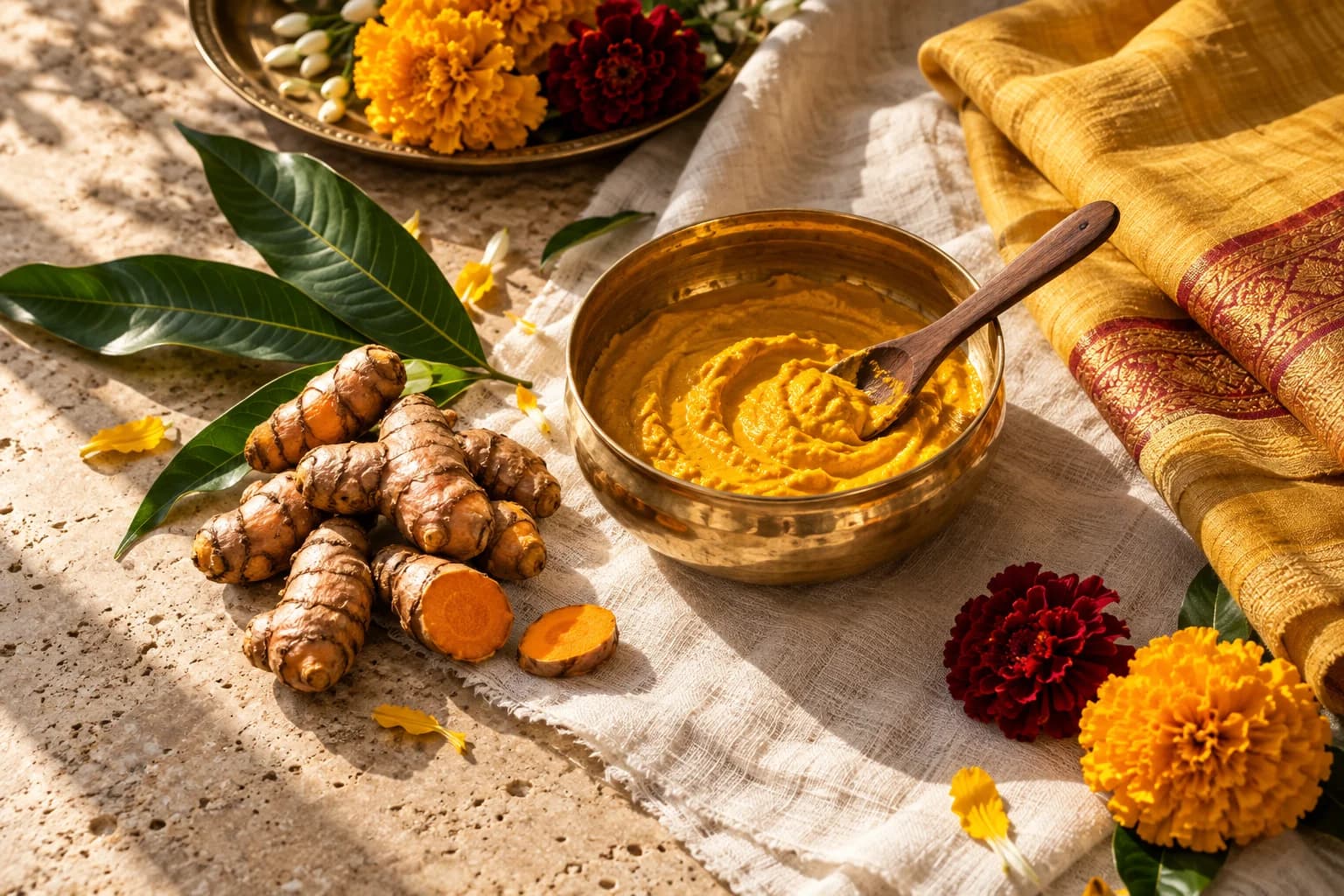
Yellow is an auspicious colour in Hindu tradition, linked with new beginnings, and turmeric has been prized in Indian homes for centuries, in the kitchen and in Ayurveda, where it has long been used in skincare. The paste is meant to leave the couple glowing for the wedding, and to mark the start of the most important days of their lives.
The paste itself is an ubtan, made at home. A common mix is turmeric, gram flour, a little sandalwood and rose water or milk, though every family has its own version. If you are making it, try a little on the inside of the wrist a few days before, and plan outfits around the fact that turmeric stains.
- Turmeric: the colour and the heart of the ritual
- Gram flour (besan): body and a gentle scrub
- Sandalwood: fragrance and a cooling feel
- Rose water or milk: to bring it to a paste
Who applies the haldi, and why it is family
Haldi is never handed to professionals. Elders and married women of the family usually begin, then siblings, cousins and friends join in, each adding their blessing with their hands. In some homes turmeric that has touched the groom is sent to the bride’s house, so that the same haldi touches them both; in Bengali weddings it travels with the gifts for the bride on the morning of the gaye holud.
Every hand that touches the couple adds a blessing.
Protection from the evil eye
Many families believe haldi protects the couple from nazar, the evil eye, at a time when everyone’s attention is on them. That is why, after their haldi, the bride and groom are often asked not to step out of the house until the wedding. In some homes a sacred thread, sometimes with a small piece of turmeric root knotted into it, is tied on their wrist as well.
The part everyone remembers
Haldi is one of the most relaxed functions of the wedding. Guests wear yellow, songs are sung, flower petals fly, and the ritual often ends with the whole family covered in turmeric. Then the couple bathe, and the next part of the wedding begins.
Haldi on your invitation
Give the haldi its own line with a time and place, since it is often a morning function at home. Add a dress note, such as shades of yellow, and a friendly warning that clothes may get stained. If the bride’s and groom’s haldi happen separately, send each side’s guests the details for theirs.
Haldi invitation and ceremony messages
Hindu wedding invitations: wording, functions and templates
Quick answers
- Why is haldi applied before the wedding? As a blessing from the family, for a glowing start, and in many families as protection from the evil eye.
- When is the haldi ceremony? Usually a day before the wedding or on the morning itself.
- What is in haldi paste? Most commonly turmeric, gram flour, sandalwood and rose water or milk, though recipes vary.
- What should guests wear to a haldi? Yellow is traditional. Choose something you do not mind staining.
Written by Inviteeq Editorial, with care for every celebration.