Wedding shopping in Jaipur: where to buy what (2026 guide)
Where to shop for a wedding in Jaipur: Johari Bazaar for kundan and gold, Purohit ji ka Katla for lehengas, Bapu Bazaar for bandhani and mojris, and the checks to make before you pay.
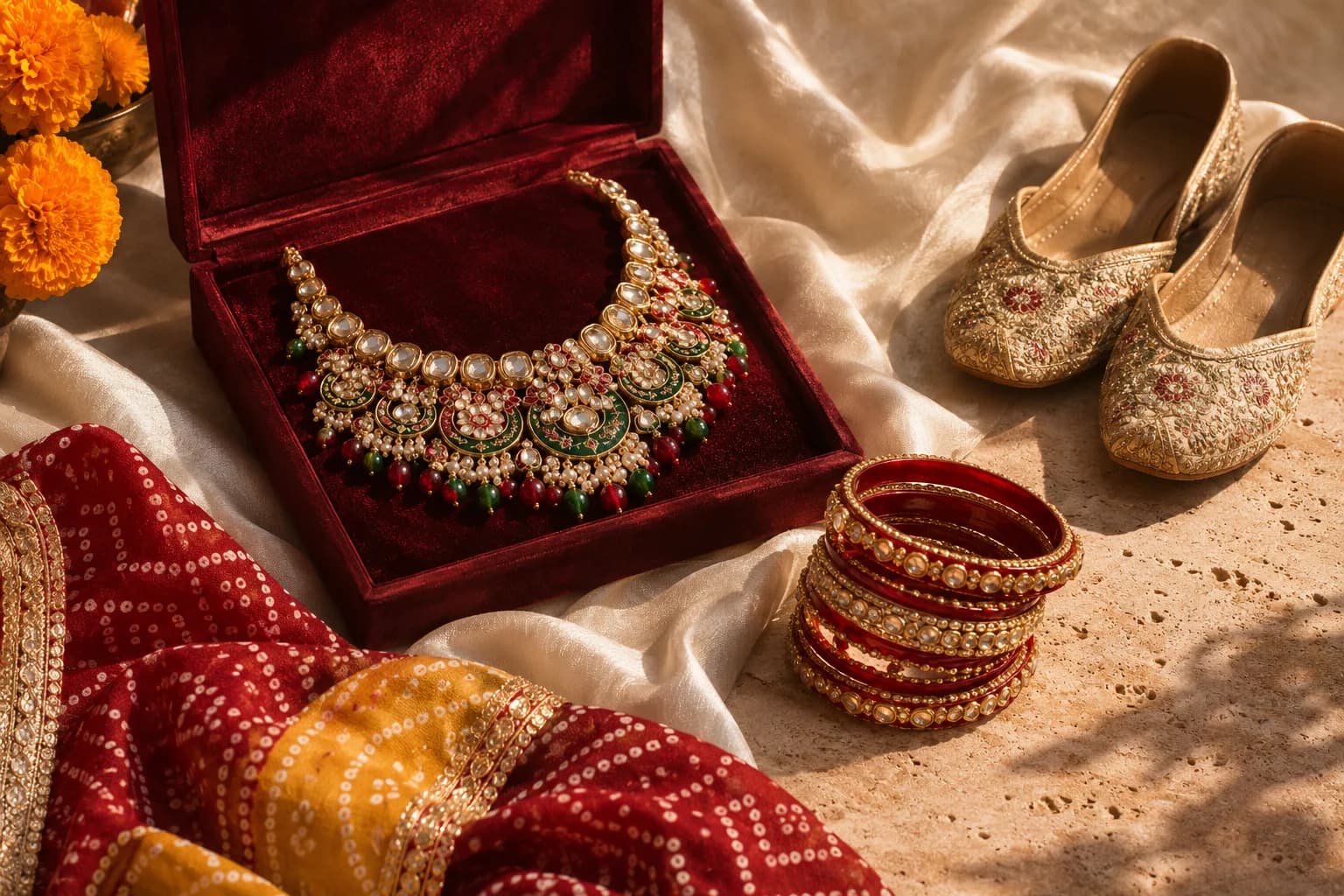
For wedding shopping in Jaipur, go to Johari Bazaar for gold, kundan and meenakari jewellery, and to Purohit ji ka Katla, off Johari Bazaar Road, for lehengas and wedding wear. Bapu and Nehru Bazaar are the places for bandhani, leheriya and mojris, Maniharon ka Rasta off Tripolia Bazaar for lac bangles, and Sanganer for block prints. Shop Monday to Saturday.
Jaipur’s old city was laid out with a lane for each trade, and much of that survives. This guide covers the markets that the city corporation, Rajasthan Tourism and recent shopping guides consistently name. It names markets rather than individual shops, because a market will still be there next season.
When to go, and the Sunday question
Rajasthan Tourism says Jaipur’s markets ‘are generally closed on Sundays’, and many old-city shops still keep Sunday as their weekly off. Other sources disagree market by market: the city corporation’s market page lists Johari, Bapu, Nehru and Kishanpole Bazaar as open every day, and only Tripolia Bazaar as closed on Sundays. Treat Sunday as a gamble.
- Shop from about 11 am, when most shops are open, until about 8 pm
- Tripolia Bazaar is closed on Sundays, a point every source we checked agrees on
- A local guide notes that parts of Johari Bazaar close on Tuesdays, so jewellery buyers may want to avoid Tuesday too
- October to March is the comfortable season for walking the bazaars; from April to June, shop in the evening
- Markets are at their busiest before Dev Uthani Ekadashi, which opens the wedding season, and around Diwali, when Bapu, Nehru and other old-city bazaars have in recent years been made no-vehicle zones
Dev Uthani Ekadashi: why weddings begin after Diwali
Johari Bazaar: bridal jewellery
Johari means jeweller, and Johari Bazaar is the city’s best-known jewellery street, running from Badi Chaupar towards Sanganeri Gate. Shops sell gold and silver, kundan (stones set in fine gold foil), meenakari (enamel work, often on the back of a piece), polki and loose gemstones. The working lanes behind it, Gopalji ka Rasta and Haldiyon ka Rasta, are where much of the trade happens. Some shops on the main road also carry bandhani and leheriya sarees and odhnis.
- Best for: the bridal set, gold, kundan, meenakari and polki, plus a bandhani odhni
- Budget: everything from a modest silver piece to sets worth several lakhs
- Weekly off: listed as open daily, but parts may close on Tuesdays; confirm with the shop
- Tip: read the jewellery checks further down before you pay
Purohit ji ka Katla: lehengas and wedding wear
Purohit ji ka Katla, a market off Johari Bazaar Road, is the market shopping guides recommend for wedding wear. It is known for bridal lehengas, silk and georgette sarees and trousseau shopping, with matching accessories, sherwanis for the groom, invitation cards and gift boxes in the same lanes. A good part of a wedding list can be done in one visit.
- Best for: bridal and function lehengas, sarees, trousseau, groom’s wear, gift packing
- Budget: wide range; compare several shops before committing
- Tip: anything that needs fitting needs time, so do not plan to buy and alter a bridal lehenga in a two-day trip
Bapu Bazaar: bandhani, leheriya and mojris
Bapu Bazaar, inside the south wall near New Gate, is the market for bandhani (tie-dye) and leheriya (wave-dyed) dupattas and sarees, block-printed kurtis, juttis and mojris, bags and gifts. Guides also list lehengas and Rajputi poshaks here. Quality varies a lot within a few shops, so check the stitching on footwear and the back of any embroidery.
- Best for: haldi and mehndi dupattas, bandhani for the family, mojris for the couple, small gifts
- Budget: budget to mid-range, with first prices often set high
- Weekly off: sources disagree; several list Sunday, the city page lists it as open daily
- Approximate prices, as of 2026 (confirm directly): souvenir juttis about ₹400 to ₹1,200, good leather mojris about ₹1,200 to ₹3,500 or more
Nehru Bazaar: juttis and fabric on a budget
Nehru Bazaar runs right beside Bapu Bazaar and sells more juttis, fabric and small gifts. Guides describe it as generally cheaper and rougher than Bapu, which suits bulk buying for cousins and return gifts.
- Best for: juttis in bulk, fabric, inexpensive gifts
- Budget: budget
- Weekly off: sources disagree (Sunday in most, Tuesday in one, open daily on the city page)
Tripolia Bazaar and Maniharon ka Rasta: lac bangles
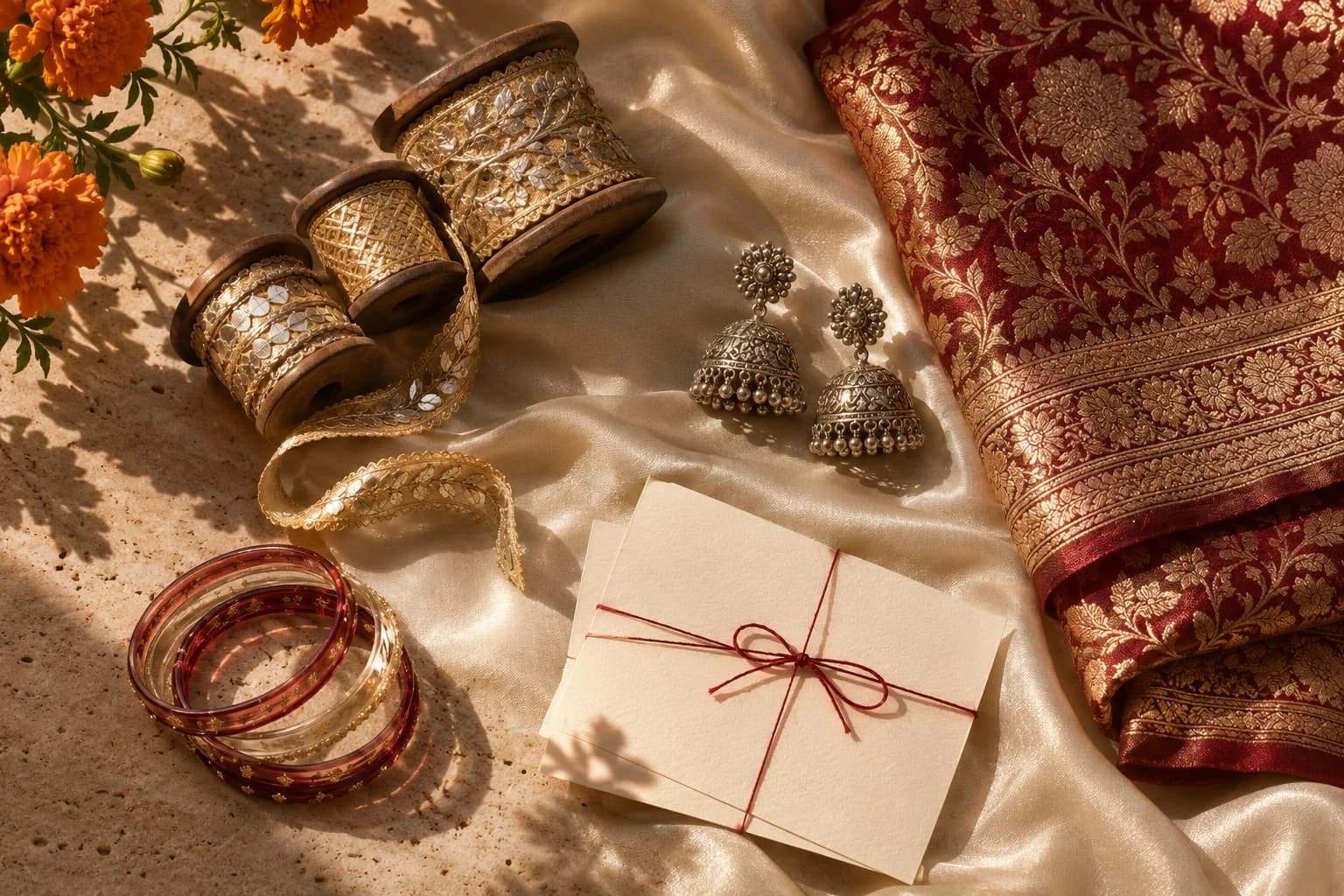
Tripolia Bazaar, between Badi Chaupar and Chhoti Chaupar, is a working market for brass, copper and ironware, textiles and lac bangles. Off it, Maniharon ka Rasta is the lane of the Manihar families, who make lac bangles and can size a set to your wrist while you wait. It is the place to order matching sets for the bride, the bridesmaids and the mehndi.
- Best for: lac bangles and bangle sets, brass and copper gifts
- Budget: budget; approximate price for a simple lac bangle set, as of 2026: about ₹200 to ₹1,000 (confirm directly)
- Weekly off: Sunday
- Tip: ask whether the stones are set or glued, and keep lac away from heat, since it softens
Kishanpole and Chandpole Bazaar
Kishanpole Bazaar, running south from Chhoti Chaupar, sells Rajasthani dyed fabrics, bandhani, wood carving and ittar (perfume oils), and is quieter than Bapu Bazaar. Small bottles of ittar make an easy return gift. Chandpole Bazaar, out towards Chandpole Gate, is known for marble carving and handicrafts rather than wedding clothes; visit only if you want a marble murti or décor.
MI Road and Rajasthali: showrooms and fixed prices
MI Road, outside the south wall, is lined with established jewellery houses, textile showrooms and bridal stores. Rajasthali, the state government’s handicrafts showroom, is here too, with fixed prices (check it is open before a special trip). It is a useful first stop to learn what things should cost before you bargain in the bazaars. You pay for the overheads, but get proper bills and an address to return to.
Sanganer and Bagru: block prints at the source
Sanganer, just south of the city, is known for fine floral block printing on white and off-white cloth, and Bagru, about 30 km west, for earthier prints and dabu, a mud-resist technique. Both are registered Geographical Indications. Sanganer is also known for handmade paper, worth a look if you want printed cards or tags for gift boxes. Block-printed stoles, dupattas and cushion covers make good return gifts in bulk.
What to buy where: the short list
- Bridal jewellery (gold, kundan, meenakari, polki): Johari Bazaar and its lanes, or MI Road showrooms
- Bridal and function lehengas, sarees, groom’s sherwani: Purohit ji ka Katla
- Bandhani and leheriya dupattas and sarees: Bapu Bazaar, Johari Bazaar, Kishanpole Bazaar
- Mojris and juttis: Bapu and Nehru Bazaar
- Lac bangles: Maniharon ka Rasta, off Tripolia Bazaar
- Block prints: Bapu Bazaar, or Sanganer and Bagru at the source
- Return gifts: lac bangle sets, block-print stoles, juttis, small bottles of ittar from Kishanpole, blue pottery from Rajasthali
- Fixed-price benchmark: Rajasthali on MI Road
Gold and gemstone checks before you pay
Since July 2021, hallmarked gold jewellery in India carries three marks: the BIS logo, the purity in carat and fineness (such as 22K916), and a six-digit alphanumeric HUID code unique to that piece. Open the government’s BIS Care app, choose Verify HUID and type the code: it shows the purity, the type of item and the jeweller who had it hallmarked. If a hallmarked piece later tests below its marked purity, BIS rules entitle you to compensation.
- Look for all three marks, and ask for a magnifying glass if you cannot read them
- Ask for a bill that lists each item with its net weight, purity and hallmarking charges separately, plus stone details and making charges
- For costly coloured stones, a certificate printed by the seller proves little; ask for an independent report
- IIGJ Lab, the testing lab of the Gem and Jewellery Export Promotion Council (formerly GTL Jaipur), takes pieces at collection centres on MI Road and Johari Bazar Road
- Any BIS-recognised assaying and hallmarking centre can test gold for a fee
- Get buy-back and exchange terms written on the bill, and pay by card or bank transfer for anything expensive
Akshaya Tritiya: why people buy gold, and why it is a wedding day
Bargaining, guides and commission shops
Bargaining is normal in the bazaars and out of place in fixed-price shops like Rajasthali. Ask the price, compare the same item in three shops, then make one reasonable offer and stick to it. Buying gifts in bulk is the easiest way to bring the price per piece down.
Drivers and guides are often paid a commission by the shops they bring you to, and that cost ends up in your price. Name the bazaar you want and get off there. Walk away from ‘government emporium’ stops you did not ask for, sudden closing-down sales, and anyone offering gemstones to resell at a profit.
Planning a shopping trip from out of town
- Fix your colours and budget per function before you travel, so you are choosing, not browsing
- Plan two or three visits for a bridal lehenga: selection, a trial and pickup, with two to three weeks to spare before the wedding
- Carry the blouse, heels and jewellery style you will wear, and photos for the tailor
- Ask how many days alterations take, and get advance, refund and exchange terms in writing
Keep every advance and bill in one place as you go. The free budget calculator splits your total across outfits, jewellery and gifts and tracks what is paid and still due, function by function.
Plan your shopping with the free wedding budget calculator
Mayra: why Mama ji arrives at a Marwari wedding with truckloads of gifts
Bridal shopping list: the complete Indian wedding checklist
Best places for wedding shopping in Delhi (2026 guide)
Best places for wedding shopping in Mumbai (2026 guide)
Quick answers
- Which market is best for wedding shopping in Jaipur? Johari Bazaar for jewellery and Purohit ji ka Katla, off Johari Bazaar Road, for lehengas and wedding wear. Bapu Bazaar covers bandhani, mojris and gifts.
- Is Johari Bazaar good for bridal jewellery? Yes. It is Jaipur’s jewellery street, known for gold, kundan, meenakari and polki. Check the BIS hallmark and HUID before you pay.
- Does Bapu Bazaar sell lehengas? Yes, along with bandhani, leheriya and Rajputi poshaks, but most brides go to Purohit ji ka Katla for bridal lehengas.
- Are Jaipur markets closed on Sunday? Many shops are. Tripolia Bazaar closes on Sundays, and sources disagree on the others, so shop Monday to Saturday.
- Where can I buy lac bangles in Jaipur? In Maniharon ka Rasta, off Tripolia Bazaar, where families make them and size them to your wrist.
- How do I check gold jewellery in Jaipur? Look for the BIS logo, the purity mark and the six-digit HUID code, and verify the HUID in the BIS Care app.
Rajasthani wedding invitations: royal wording and templates
Written by Inviteeq Editorial, with care for every celebration. How we write and check these stories