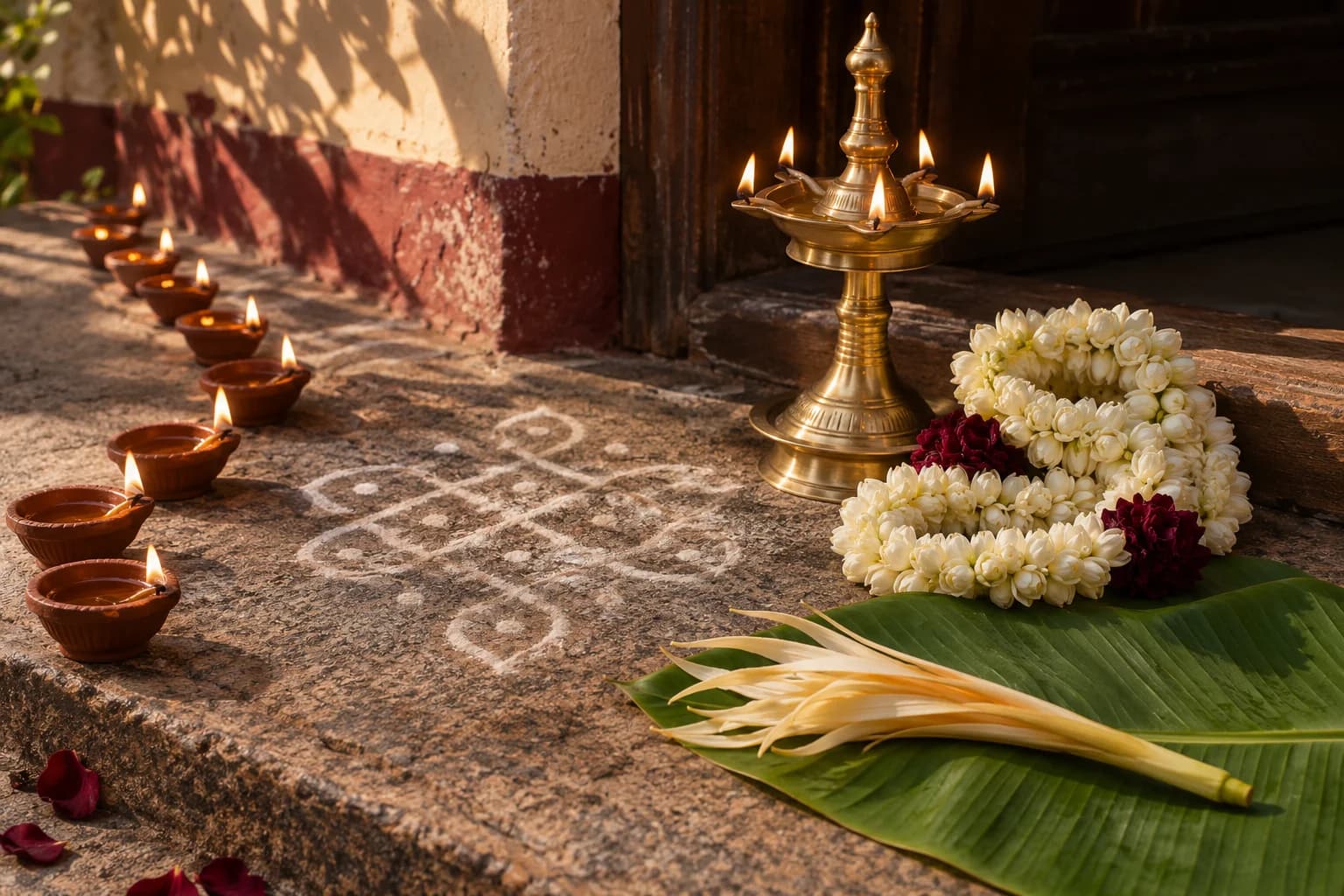
Ugadi pachadi: why bitter neem is eaten on New Year’s day
On Ugadi, the first thing eaten is Ugadi pachadi: neem flowers, jaggery, tamarind, raw mango, salt and chilli. Why the six tastes, what Yugadi means, Brahma ji’s creation, and the Gudi of Gudi Padwa.
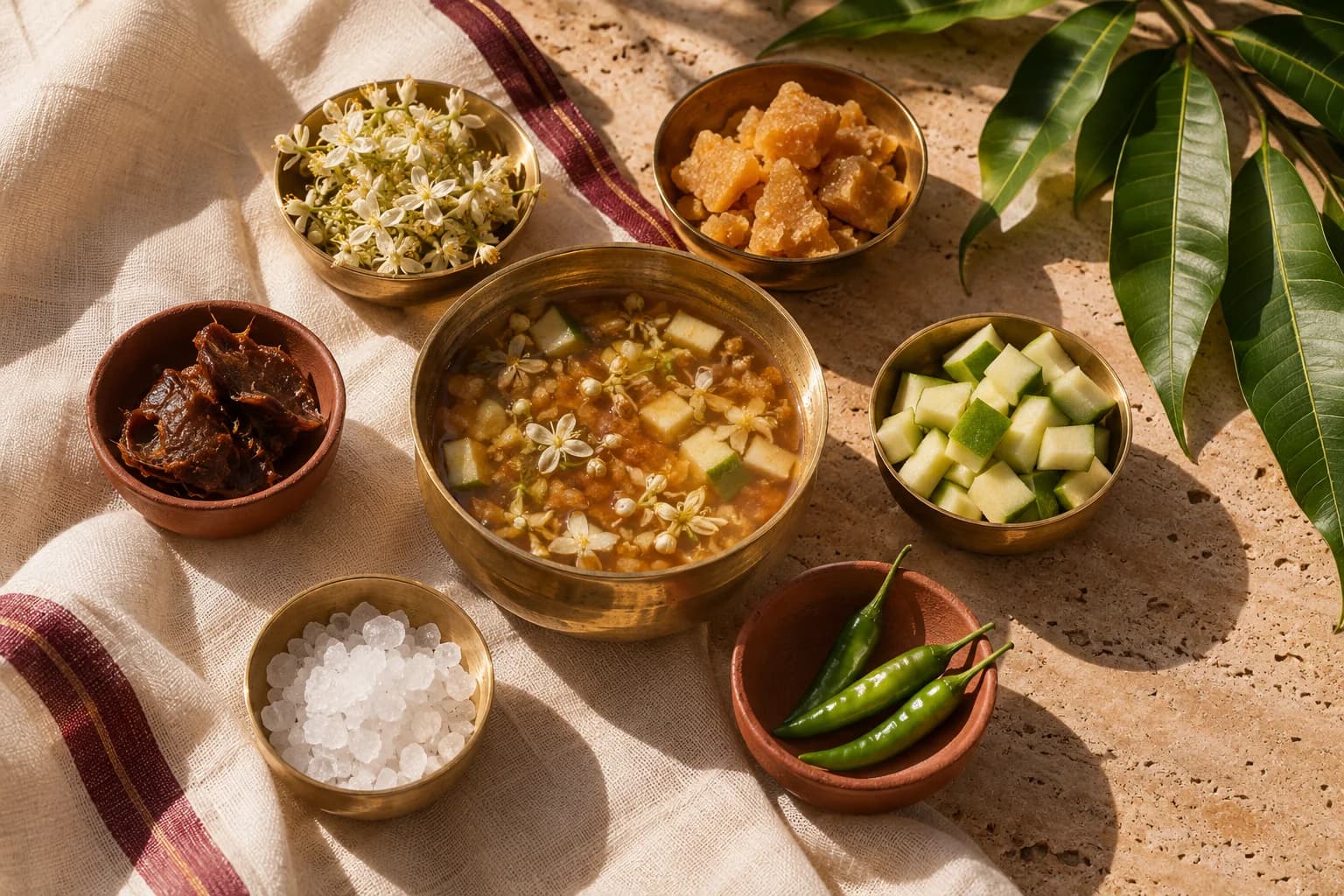
On Ugadi, the new year’s day of Telugu and Kannada homes, the first thing eaten in the morning is Ugadi pachadi. It mixes six tastes, the shadruchi: bitter neem flowers, sweet jaggery, sour tamarind, tangy raw mango, salt and spicy chilli. The bitter neem is there on purpose: the new year will bring every taste, so take them all together.
Most new years begin with something sweet. Ugadi begins with a small bowl in which the sweet comes mixed with the bitter, the sour and the hot, and everyone in the house takes a spoonful before anything else. Kadwa neem, on the first day of the year? There is a reason, and it is in the bowl.
What does Yugadi mean?
Yugadi, the name the day goes by in Karnataka, is yuga plus aadi: the beginning of a yuga, the start of a new age. Ugadi comes from the same words. The day falls on Chaitra Shukla Pratipada, the first day of the bright half of Chaitra, which is why it opens the year for those who follow this lunar calendar.
Maana jaata hai, it is believed, that Brahma ji began creation on this very day. The belief rests on a verse from the Brahma Purana, quoted in Hemadri’s Chaturvarga Chintamani, which says that Brahma created the world on the first day of the bright half of Chaitra, at sunrise. So the new year is also, as it is popularly told, the first day of creation.
Yugadi, yaani yug ka aadi… naye yug ki shuruaat. Yugadi: the beginning of a yuga… the start of a new age.
In 2027, Ugadi and Gudi Padwa fall on Wednesday 7 April, according to drikpanchang.com for New Delhi, with Pratipada from 5:20 am on 7 April to 4:28 am on 8 April. Dates can vary by region and panchang.
Ugadi pachadi: six tastes in one bowl
On Ugadi morning, the very first thing is the pachadi. Shadruchi means six tastes, and each ingredient brings one of them:
- Neem flowers: bitter (kadwa)
- Jaggery: sweet (meetha)
- Tamarind: sour (khatta)
- Raw mango: tangy (kasaila)
- Salt: salty (namkeen)
- Green chilli or pepper: spicy (teekha)
It is the neem’s flowers that go in, small and creamy white, not the leaves. The proportions change from kitchen to kitchen, and so does the exact list. Every family has its recipe, and every family thinks theirs is the right one.
What the six tastes mean
However the recipe changes, the message stays the same. The year ahead will not be only sweet. It will bring happiness and sorrow, surprise and anger, good news and bad, and the pachadi asks you to taste all of it together, at the very start, and to accept that a whole year is made of all of them. How each taste is read differs a little from family to family and region to region.
Ghar-ghar recipe alag… par sandesh ek: saal har swaad laayega, sab saath chakho! Every home’s recipe differs… but the message is one: the year will bring every taste, so take them all together!
Gudi Padwa: neem with jaggery, and a Gudi on the balcony
The same day is Gudi Padwa in Maharashtra, which drikpanchang describes as the first day of the year for Maharashtrians and Konkanis. Here too the day begins with bitterness and sweetness together: neem leaves with jaggery, taken as the day’s prasad.
And at a window or on the balcony goes up the Gudi: a bamboo staff dressed in silk cloth, with neem and mango leaves, a garland of marigolds and one of sugar crystals, and an upturned copper kalash on top. Customs vary from town to town and home to home, but the Gudi, raised high, is the sign of the day.
A wedding has six tastes too
The reel ends where Aisa Kyun? always ends, at a wedding, and a wedding turns out to be a shadruchi of its own. Sweet: the mithai. Sour: Fufa ji’s mood. Spicy: Bua ji’s comments. Bitter: the budget. Salty: the tears at the vidaai. And the sixth taste? That one is up to you.
Shaadi bhi shadruchi hai! Meetha: mithai. Khatta: Fufa ji ka mood. Teekha: Bua ji ke comments. Kadwa: budget! Namkeen: vidaai ke aansu. A wedding has six tastes too! Sweet: the mithai. Sour: Fufa ji’s mood. Spicy: Bua ji’s comments. Bitter: the budget! Salty: the vidaai tears.
Keep the invitation sweet
You cannot take the bitter out of a wedding budget, but you can keep the invitation the sweet part: easy to open and easy to follow. List each function on its own line with its date, time, venue and a map link, so nobody has to ring the family to ask. The reel shows Simple, the clean layout on Wedding Card Maker that follows the colours of whichever theme you choose: guests open it with one tap and scroll through every function and venue.
Give a clear reply-by date, one that leaves time to confirm numbers with the caterer, and ask guests to reply for each function, since the mehndi, the wedding and the reception rarely have the same count. Some replies, of course, will take their time.
Waise… Dada ji ne chhe mein se bas gud chuna. Neem? ‘Agle saal!’ By the way… of the six, Dada ji picked only the jaggery. The neem? ‘Next year!’
Hindu wedding invitations: wording, functions and templates
Work out your RSVP date with the free deadline calculator
Why is New Year on 1 January? And why September is month nine
Quick answers
- What is Ugadi pachadi? The dish eaten first on Ugadi morning, mixing six tastes: neem flowers, jaggery, tamarind, raw mango, salt and chilli or pepper.
- Why is neem eaten on Ugadi? Its bitterness stands for the hard parts of the year ahead; the pachadi’s message is to take every taste together.
- What does Yugadi mean? Yuga plus aadi: the beginning of a new age. It is believed Brahma ji began creation on this day.
- Are Ugadi and Gudi Padwa on the same day? Yes, both fall on Chaitra Shukla Pratipada. In 2027 that is Wednesday 7 April, according to drikpanchang.com for New Delhi.
Written by Inviteeq Editorial, with care for every celebration. How we write and check these stories