Ram Navami puja time: why the puja is held at midday
The Ram Navami puja is held at madhyahna, midday, because Shri Ram is believed to have been born then. What Tulsidas wrote, the Sun and the Suryavansh, the cradle at noon and kanya pujan.
The Ram Navami puja is held at madhyahna, midday, because Shri Ram is believed to have been born at that hour, on Chaitra Shukla Navami. Tulsidas describes the moment in the Ramcharitmanas as midday, neither too cold nor too hot. At noon the Sun is at its highest, and Ram ji is a Suryavanshi.
Most festivals belong to the early morning or to the night: the dawn aarti, the diyas after dark. Ram Navami is different. As the Sun climbs to the top of the sky, the temple bells begin, the conches sound and a little cradle starts to swing.
Born at midday on Chaitra Shukla Navami
Maana jaata hai, it is believed, that Shri Ram was born on Chaitra Shukla Navami, the ninth day of the bright half of Chaitra, exactly at madhyahna. The Valmiki Ramayana places his birth on Chaitra Navami, under the Punarvasu nakshatra, and commentators commonly read its description as the Sun at its height, which is midday.
That is why panchangs keep Ram Navami on the day when Navami falls in the madhyahna, the middle part of the daytime, and why the puja muhurat is a midday window. Ram Navami usually falls in March or April. In 2027 it is on Thursday 15 April, and drikpanchang.com gives the madhyahna muhurat for New Delhi as 11:04 am to 1:38 pm. The time changes from city to city, so check your own panchang.
What Tulsidas wrote
In the Bal Kand of the Ramcharitmanas, Tulsidas describes the hour of the birth: the holy month of Madhu, as Chaitra is also called, the ninth tithi, and the middle of the day, when it was neither too cold nor too hot.
Naumi tithi madhu maas puneeta, madhya diwas ati seet na ghaama. The ninth tithi of the holy month of Madhu, midday, neither too cold nor too hot.
The Sun at its highest, and a Suryavanshi
At midday the Sun stands at its highest, and a pole’s shadow is at its shortest. Ram ji belongs to the Suryavansh, the solar dynasty of the Ikshvaku kings of Ayodhya. Many people find meaning in the two belonging together: a son of the Sun’s line, born when the Sun is at its peak. That link is a reflection people draw, not a line from scripture.
Bells, a cradle and the Saryu
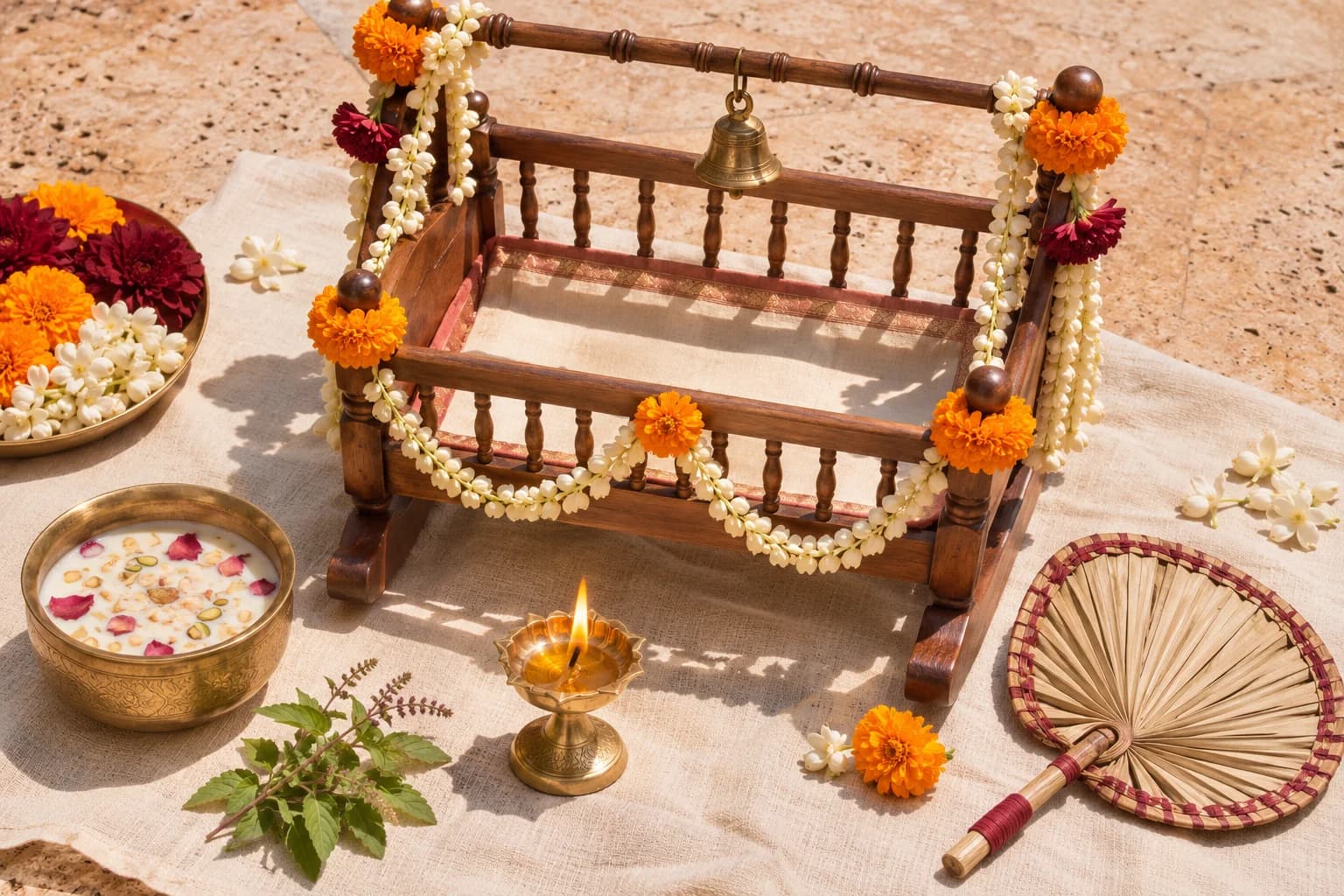
As the midday moment arrives, temples ring their bells and blow conches, and an empty, decorated cradle, the paalna, is swung for Ram Lalla, the infant Ram, while devotees sing badhai, songs of celebration for a birth. In Ayodhya the celebrations fill the Ram Janmabhoomi temple and the ghats along the river Saryu.
And Chaitra Navratri ends
Ram Navami is also the ninth and last day of Chaitra Navratri. In many homes it is the day of kanya pujan, when young girls are invited, honoured and fed puri, halwa and chana. Some families hold kanya pujan on Ashtami, the eighth day, instead; it depends on family custom.
And in every family there is one Bade Papa, a father’s elder brother, who sets an alarm for the muhurat and then presses snooze.
Bole, ‘Madhyahna toh kal bhi aayega!’ He said: ‘Midday comes tomorrow too!’
The muhurat on your invitation
A muhurat is a window, not a whole day, so give it on your invitation as a clock time guests can plan around, and say which city’s panchang it follows if guests are travelling. Once the date and muhurat are fixed, send them to everyone first, before the full details are ready. If any of your functions fall during Navratri, remember that some guests will be fasting, and ask about food needs when they reply. And put the pheras’ time on the card, not just the reception’s, so nobody misses the muhurat itself.
Hindu wedding invitations: wording, functions and templates
First wedding card to Ganesh ji, and the lagna patrika
Shiv ji ki baraat: why ghosts and ganas danced at Shiva’s wedding
Quick answers
- Why is the Ram Navami puja done at midday? Shri Ram is believed to have been born at madhyahna, midday, on Chaitra Shukla Navami.
- What is the Ram Navami puja time? The madhyahna muhurat, a midday window that changes from city to city; check your local panchang.
- What did Tulsidas write about Ram’s birth? In the Ramcharitmanas he describes the ninth tithi of the holy month, at midday, neither too cold nor too hot.
- Is Ram Navami the last day of Navratri? Yes, it is the ninth day of Chaitra Navratri, and many homes hold kanya pujan on it or on Ashtami.
Inviteeq Editorial द्वारा लिखा गया। हम ये लेख कैसे लिखते और जाँचते हैं