Arundhati star: why a bride is shown a star after the wedding
The Grihya Sutras ask that the bride be shown Dhruva, the Pole Star, and Arundhati, the faint star beside Vasishtha in the Saptarishi. Why, how to find her, and what astronomers call the pair.
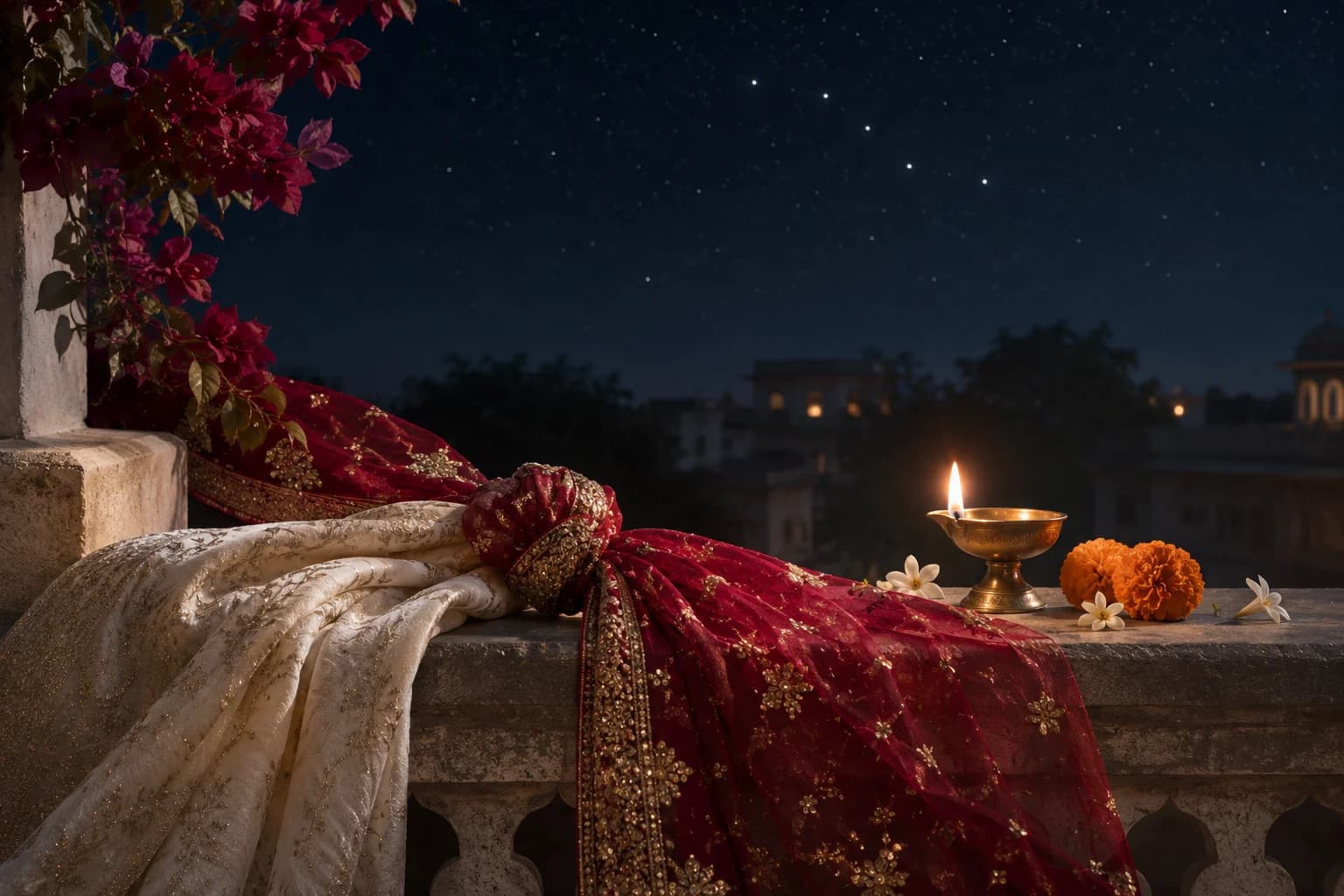
After the wedding, at night, the bride is shown two stars: Dhruva, the Pole Star, which seems never to move, and Arundhati, a faint star right beside Vasishtha in the Saptarishi. The Grihya Sutras prescribe it, and many weddings still keep it. Dhruva stands for steadiness; Arundhati, the wife of rishi Vasishtha, for a bond that never breaks.
The rituals are done, the guests are drifting home, and someone points the new couple at the sky. Find the seven stars of the Saptarishi, the group also known as the Big Dipper. Now find the middle star of its handle. Look very closely beside it.
What the Grihya Sutras say
The Grihya Sutras are the old manuals of household rites, the wedding among them, and several describe this moment. The Paraskara Grihya Sutra says that after sunset the groom shows the bride the firm star, Dhruva. The Ashvalayana Grihya Sutra names Dhruva, Arundhati and the Seven Rishis, after which the bride breaks her silence. The Gobhila Grihya Sutra has Dhruva, then Arundhati.
Grihya sutron mein vidhi hai: vivah ke baad, raat ko, dulhan ko Dhruv aur Arundhati dikhaao… kai shaadiyon mein aaj bhi! The Grihya Sutras lay it down: after the wedding, at night, show the bride Dhruva and Arundhati… and many weddings still do!
Arundhati paarthal and Arundhati darshanam
Many weddings still include it. In Tamil Brahmin weddings it is part of ‘ammi midhithu Arundhati paarthal’, which pairs stepping on the grinding stone with seeing Arundhati. In Telugu weddings it is Arundhati nakshatra darshanam, the sight of the Arundhati star. Families in other communities keep it too, and customs vary from family to family and region to region.
Dhruva: the star that stays
Dhruva is today’s Pole Star, Polaris. It sits so close to the point in the sky above the Earth’s north pole that, while the rest of the sky turns through the night, it seems to stay in one place. That is the point of showing it: a marriage meant to hold steady while everything else moves.
‘Seems’ is the honest word. Polaris is a little under a degree from the true pole, and over thousands of years the pole slowly drifts, so the Pole Star changes too.
Dhruv yaani Pole Star… jo hamesha ek jagah tika lagta hai. Dhruva is the Pole Star… the one that seems to stay in one place forever.
Arundhati and Vasishtha
Arundhati was the wife of rishi Vasishtha, one of the Saptarishi, the seven sages, and in the tradition she is the ideal of a devoted marriage. The seven stars of the Big Dipper are named for the seven sages, and Vasishtha’s star has a small companion right beside it: Arundhati. In the sky, as in the story, the two are never apart.
How to find Arundhati
Arundhati is faint, so you do not start with her. First find Vasishtha, the bright middle star of the Dipper’s handle. Then look right beside it for a much dimmer one. That is Arundhati.
The method is old enough to have its own name: Arundhati-darshana nyaya, the maxim of showing Arundhati. To point out something subtle, you begin with something obvious beside it, then move to the faint thing.
Pehle Vasishtha ka chamakta taara… phir theek paas, ek dhundhla sa: Arundhati! First Vasishtha’s bright star… then right beside it, a faint one: Arundhati!
Mizar and Alcor: what astronomers see
Astronomers call the pair Mizar and Alcor. They are about 12 arcminutes apart, close enough that seeing both with the naked eye has long been used as an eye test. Both are roughly 80 light-years away, and they share one motion through space as members of the Ursa Major moving group. Whether they are also bound to each other by gravity is still debated.
Science ke Mizar aur Alcor… jo sach mein saath-saath safar karte hain! Science’s Mizar and Alcor… which really do travel through space together!
Two stars, one story
If the Arundhati darshanam is part of your wedding, talk it through with your pandit and family in advance. At a morning muhurtham the star cannot be seen at all, and the old texts saw that coming: the Paraskara Grihya Sutra says that if the bride does not see the star, she should say ‘I see it’ anyway. If you would like the real thing, plan a few minutes on a rooftop or an open lawn after dark, and keep the evening’s timings on the invitation so family know to stay.
Wedding Card Maker’s Aquarelle design, the one in the reel, tells a couple’s story as a journey: one tap on ‘Begin the Journey’ washes the veil away like a drop of water, then a watercolour story leads into The Journey, where each function has its time and venue, and a map link when you add one.
Waise… sutra kehta hai: taara na dikhe, toh bhi bolo ‘dikh gaya!’ Chachu… ab tak torch se dhoondh rahe hain. By the way… the sutra says: if you can’t see the star, say ‘I see it!’ anyway. Chachu… is still searching with a torch.
South Indian wedding invitation, from nichayathartham to muhurtham
Saptapadi: the meaning of the seven steps and vows
Kashi yatra: why a South Indian groom walks out of his own wedding
Quick answers
- Why is the bride shown the Arundhati star? The Grihya Sutras prescribe showing her Dhruva and Arundhati after the wedding: Dhruva for steadiness, and Arundhati, Vasishtha’s wife, for a bond that never breaks.
- Which star is Arundhati? The faint star right beside Vasishtha, the middle star of the Saptarishi’s handle. Astronomers call the pair Alcor and Mizar.
- What is Arundhati darshanam? The Telugu name for the rite of showing the bride the Arundhati star. In Tamil weddings it is called Arundhati paarthal.
- What if the bride cannot see the star? The Paraskara Grihya Sutra says she should say ‘I see it’ anyway.
Inviteeq Editorial द्वारा लिखा गया। हम ये लेख कैसे लिखते और जाँचते हैं