Toran marna: why the groom strikes the toran with a sword
At many weddings the groom, still on his mare, touches the toran over the bride’s door with a sword or a neem twig. The folk tale of the parrot demon Toran, the carved parrots, and what torana means.
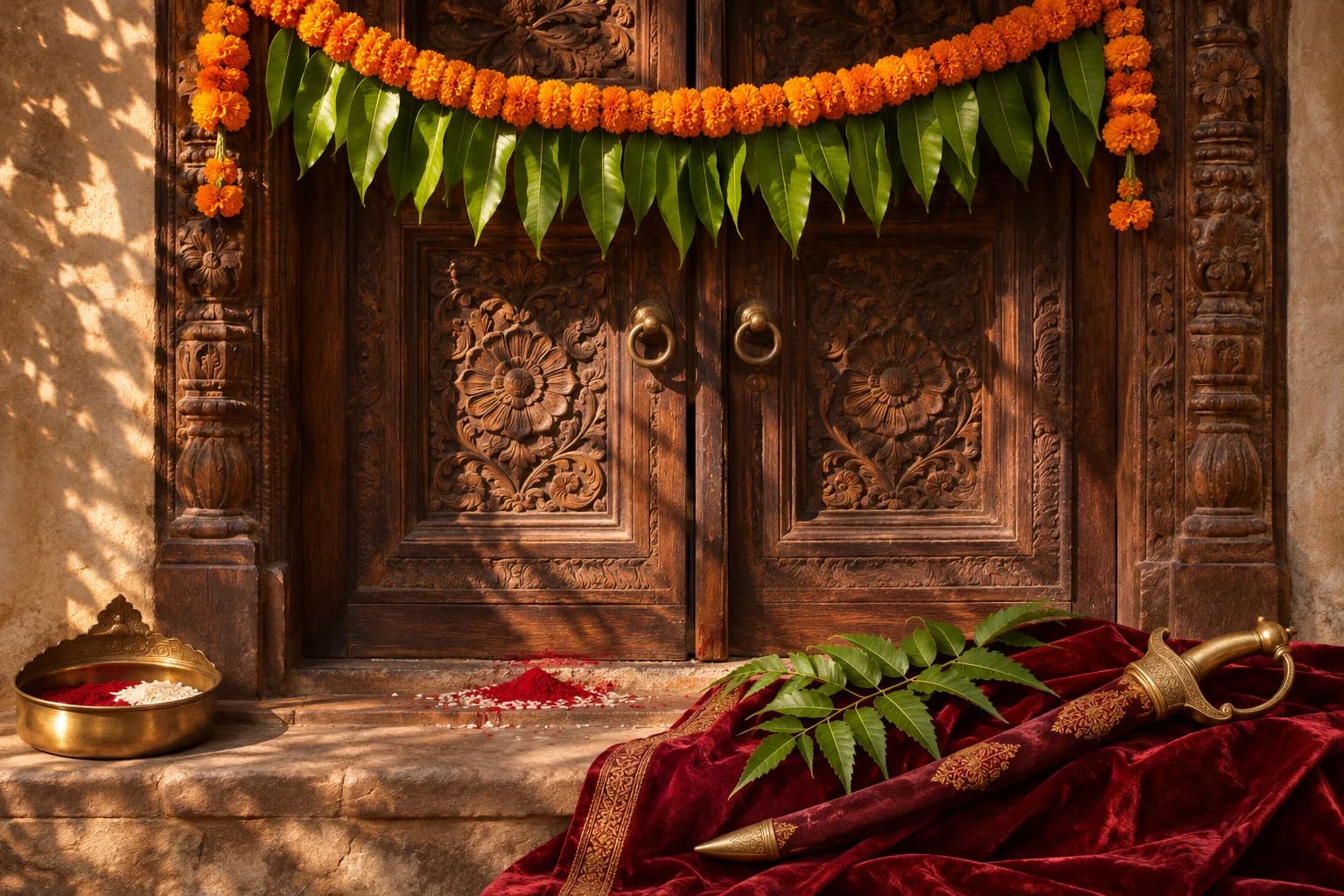
Toran marna is the moment at many weddings when the groom, still on his mare, touches or strikes the toran over the bride’s door with a sword, or in many homes a neem twig, before he is welcomed in. A popular folk tale from Rajasthan explains it: a demon named Toran sat at the bride’s door as a parrot and spoiled weddings, until a clever prince saw through him and struck with his sword.
The baraat has danced its way to the door. The bride’s mother waits with the aarti thali, the aunts crowd in behind her, and the groom raises his sword towards the decorated hanging over the doorway. Everyone has seen it happen. Far fewer people can say why.
What is toran marna?
A toran is the hanging over a doorway, and marna here means to strike. At a wedding, a toran is hung over the entrance of the bride’s home or the venue. When the baraat arrives, the groom touches it before he is welcomed in. Writers on the custom describe a sword, a dagger, an arrow or a neem branch; in many homes it is a neem twig.
The rite is common in Rajasthan and in communities in Haryana, Malwa in Madhya Pradesh and Gujarat. How it is done, and with what, varies from family to family.
The folk tale of the parrot demon
The story is a lok-katha, a folk tale, not scripture, and it is told in more than one way. Lok-katha kehti hai, the folk tale says, a demon named Toran used to sit at the bride’s door in the form of a parrot and spoil weddings. In some tellings he slips into the groom’s place and tries to marry the bride himself.
Lok-katha kehti hai, Toran naam ka rakshas dulhan ke dwaar pe baith ke shaadiyaan bigaadta tha. The folk tale says a demon named Toran sat at the bride’s door and spoiled weddings.
Then came a clever prince. He saw through the parrot, and as he reached the door, he struck it with his sword. The demon was gone, and the wedding went ahead.
Why the sword, or a neem twig
Kehte hain, they say, that is why the groom still touches the toran from the mare: he does what the prince did, and clears the door before he goes in. Where a sword is not used, a neem twig does the job. Then the welcome at the door begins.
Ghudchadi meaning: why the groom rides a ghodi to his wedding
Why the wooden toran has parrots
Look closely at a traditional wooden toran, the kind made by the village carpenter, and you will often find a carved parrot at the top and smaller parrots on either side. In the folk tale the parrot is the demon’s symbol, and so it is still there, waiting to be struck.
Some torans sold in markets now carry religious images instead, and several writers on the custom object to that, since the toran is the very thing the groom strikes.
Aur lakdi ke toran pe? Aaj bhi tote! And on the wooden toran? Parrots, to this day!
Torana: the auspicious gateway
The word is much older than the tale. In Sanskrit, torana means a ceremonial or auspicious gateway. The best known are the carved stone gateways of the Great Stupa at Sanchi, dated to about the 1st century BCE, some 2,000 years ago.
The same word lives on at every festive door. The bandanwar, a string of mango leaves and marigolds hung over the entrance at festivals and weddings, is also called a toran, and it is believed to bring good fortune. From Sanchi’s stone to the leaves over your front door, a toran marks a threshold worth crossing well.
Every wedding begins at a gate
Har shaadi ek dwaar se shuru hoti hai. Every wedding begins at a gate.
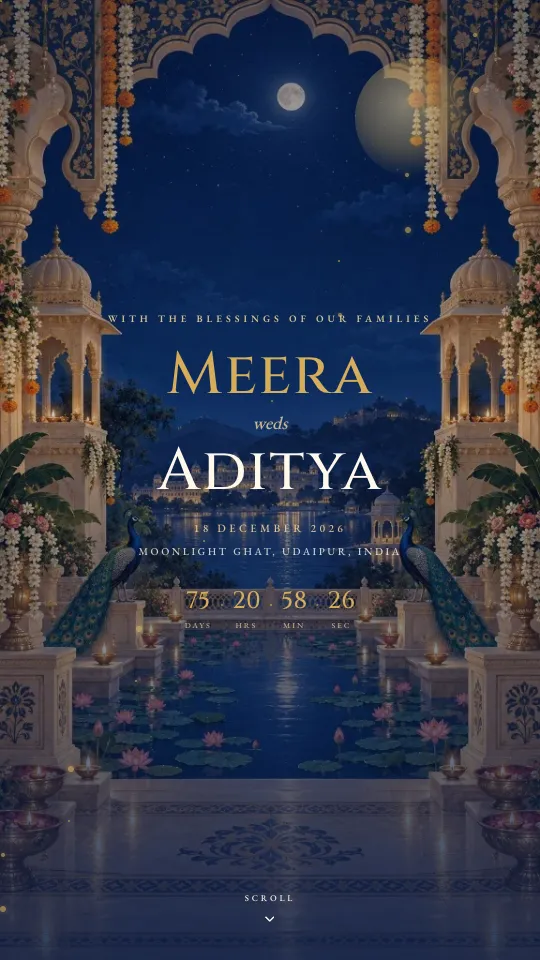
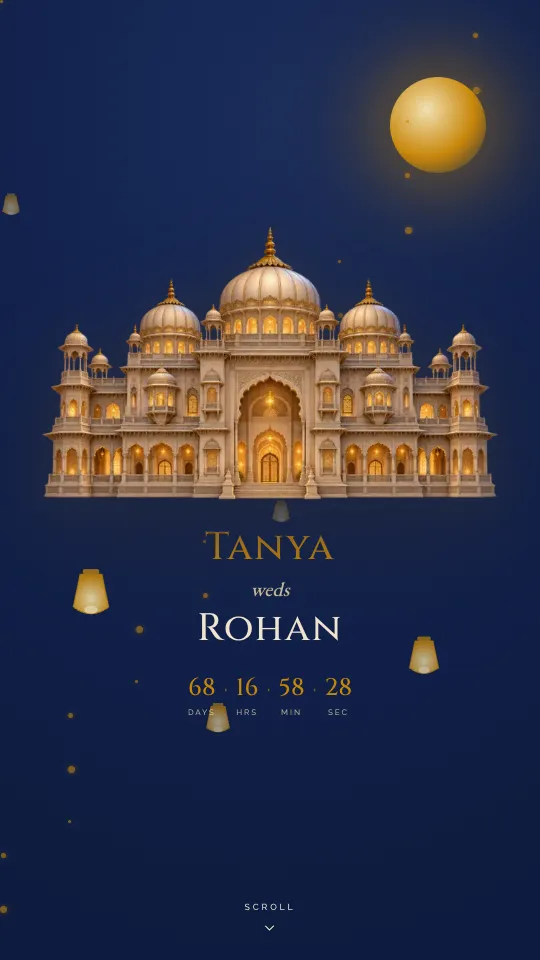
These days most guests meet your wedding at a different kind of gate: the link on their phone. Wedding Card Maker’s Moonlit Palace design, the one in the reel, opens on a ‘Tap to open’ gate. One tap reveals a sandstone haveli under a gold moon with your names and a live countdown, and each function gets its own card with its date, time and venue, and an ‘Open in Google Maps’ link.
Whichever design you choose, put the baraat’s arrival time on the invitation if the toran and the welcome at the door matter to your family, so the bride’s side is ready and waiting. Give the venue a landmark a driver can find, and ask guests to reply for each function, since the baraat, the pheras and the reception rarely have the same count. And tell the photographer and videographer when the baraat is due.
Waise… aajkal toran pe tota nahi, drone hota hai. ‘Bhaiya, ek baar aur maariye… slow-motion mein!’ By the way… these days it’s not a parrot over the toran, it’s a drone. ‘Bhaiya, strike it once more… in slow motion!’
Rajasthani wedding invitations: royal wording and templates
Ponkhanu: why a Gujarati mother-in-law grabs the groom’s nose
Work out your RSVP date with the free deadline calculator
Quick answers
- Why does the groom strike the toran? A popular folk tale from Rajasthan says a demon named Toran sat at the bride’s door as a parrot and spoiled weddings, until a clever prince struck it with his sword. The groom repeats the gesture.
- What does the groom strike the toran with? Usually a sword; in many homes, a neem twig. Customs vary by family and region.
- Why are there parrots on a wooden toran? In the folk tale the parrot is the demon’s symbol, so traditional wooden torans carry a carved parrot at the top and smaller ones at the sides.
- What does torana mean? In Sanskrit, a ceremonial or auspicious gateway, like the stone gateways of Sanchi. The mango-leaf bandanwar over a festive door is a toran too.
Escrito por Inviteeq Editorial, con cariño para cada celebración. Cómo escribimos y revisamos estas historias