Bhishma and Uttarayan: why he waited 58 days on a bed of arrows
Bhishma waited 58 days on a bed of arrows for Uttarayan, the Sun’s journey north. His boon, why Uttarayan is held auspicious, how Makar Sankranti marks it, and why weddings return after it.
Bhishma lay on a bed of arrows for 58 days because he was waiting for Uttarayan, the Sun’s journey north, believed to be the auspicious half of the year. His father Shantanu had given him the boon of choosing when he would die. Today Makar Sankranti marks Uttarayan, and it also ends Kharmas, so weddings return.
The great war at Kurukshetra is ten days old when its oldest warrior falls. Bhishma, grandsire to both sides, does not die. He lies on a bed of arrows, and he waits, for fifty-eight days. Who, or what, was he waiting for?
Iccha mrityu: a boon from his father
In the Mahabharata, Bhishma had a boon from his father, King Shantanu, given for his vow never to marry: iccha mrityu, death by his own wish. Death would come to him only when he chose it.
The tenth day
On the tenth day of the war, Bhishma fell onto a bed of arrows, the shara-shayya. He did not die. The Sun was then in its southern course, dakshinayan, and Bhishma resolved to wait: he would go only in Uttarayan.
Par Suraj dakshin mein tha. Bhishma ne thaana: Uttarayan mein hi jaaunga. But the Sun was in its southern course. Bhishma resolved: I will go only in Uttarayan.
Why he waited for Uttarayan
It is believed that Uttarayan, the half of the year when the Sun moves north, is auspicious, and an auspicious time to leave the body. So Bhishma waited. In the Anushasana Parva, he says he has lain there for fifty-eight nights, which is where the 58 days come from.
After Uttarayan had begun, in the month of Magha, Bhishma left his body. The day is popularly Magha Shukla Ashtami, the eighth day of the bright half of Magha, which is still observed as Bhishma Ashtami.
Uttarayan and Makar Sankranti
Uttarayan means the Sun’s journey north: from here on, the days grow longer. Astronomically, the Sun turns north at the winter solstice, around 21 December. The traditional calendar marks Uttarayan with Makar Sankranti, the day the Sun enters Makar, which now falls about three weeks after the solstice, in mid-January.
For 2027, Drik Panchang’s New Delhi listing has the Sun entering Makar at 9:14 pm on Thursday 14 January. As that is after sunset, the festival is observed on Friday 15 January. Dates vary by region and panchang.
Til-gud, khichdi, kites and Pongal
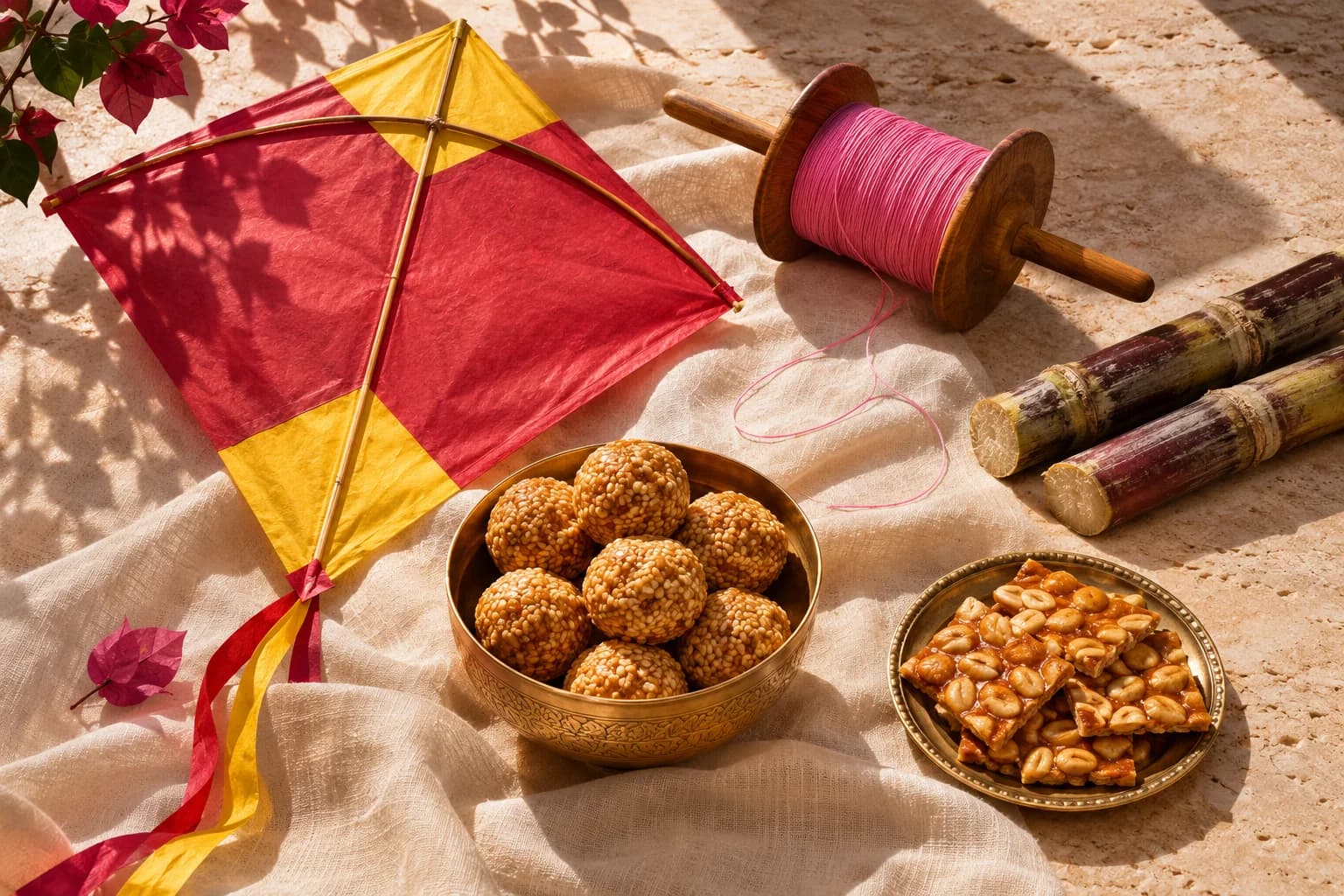
Today, Uttarayan is a festival. In North and West India, families eat til-gud, sesame and jaggery, and khichdi. In Maharashtra the greeting is til-gud ghya, god god bola: take til-gud and speak sweetly. Gujarat fills the sky with kites for Uttarayan, and kai po che is shouted every time a kite is cut. In Tamil Nadu it is Pongal, and the pot of rice and milk is left to boil over. Customs vary by region.
Waise, Fufa ji ki patang kati. ‘Kai po che!’ Ab shaadi mein bhi naaraaz hi aayenge. By the way, Fufa ji’s kite got cut. ‘Kai po che!’ Now he’ll come to the wedding sulking too.
The Sun changes direction, and the weddings return
Makar Sankranti also ends Kharmas, the month the Sun spends in Dhanu, when many North Indian families put off weddings. Once the Sun moves into Makar, the muhurats return. For 2027, the first commonly listed vivah muhurat after Kharmas is 15 January itself.
Suraj ne disha badli, aur shaadiyon ka mausam laut aaya! The Sun changed direction, and wedding season is back!
After Sankranti: your invitation
With so many families waiting for Kharmas to end, the weeks after Sankranti can fill up fast, and guests may have more than one wedding to choose between. Fix your muhurat with your pandit, then tell guests the dates as early as you can, so yours is the one they keep free. If a function falls in Sankranti week, remember that many guests will be at their own celebrations, flying kites or cooking Pongal, and give them a reply date that leaves room for the festival.
Hindu wedding invitations: wording, functions and templates
Kharmas: why there are no weddings for a month
Gita Jayanti: why 700 shlokas in the middle of a battlefield
Quick answers
- Why did Bhishma wait for Uttarayan? He had the boon of choosing when he would die, and Uttarayan is believed to be the auspicious time to leave the body.
- How long did Bhishma lie on the bed of arrows? Fifty-eight nights, by his own count in the Anushasana Parva of the Mahabharata.
- What is Uttarayan? The Sun’s journey north, when the days grow longer. The traditional calendar marks it with Makar Sankranti in mid-January.
- Why do weddings start again after Makar Sankranti? It ends Kharmas, the month when many North Indian families put off weddings.
Escrito por Inviteeq Editorial, con cariño para cada celebración. Cómo escribimos y revisamos estas historias